TOC and Lean work well together when improvement is judged by the performance of the whole system. A faster workstation, a cleaner production area or a shorter changeover can be valuable. The management question is what that change makes possible: more reliable deliveries, additional profitable sales, better quality or capacity for future demand.
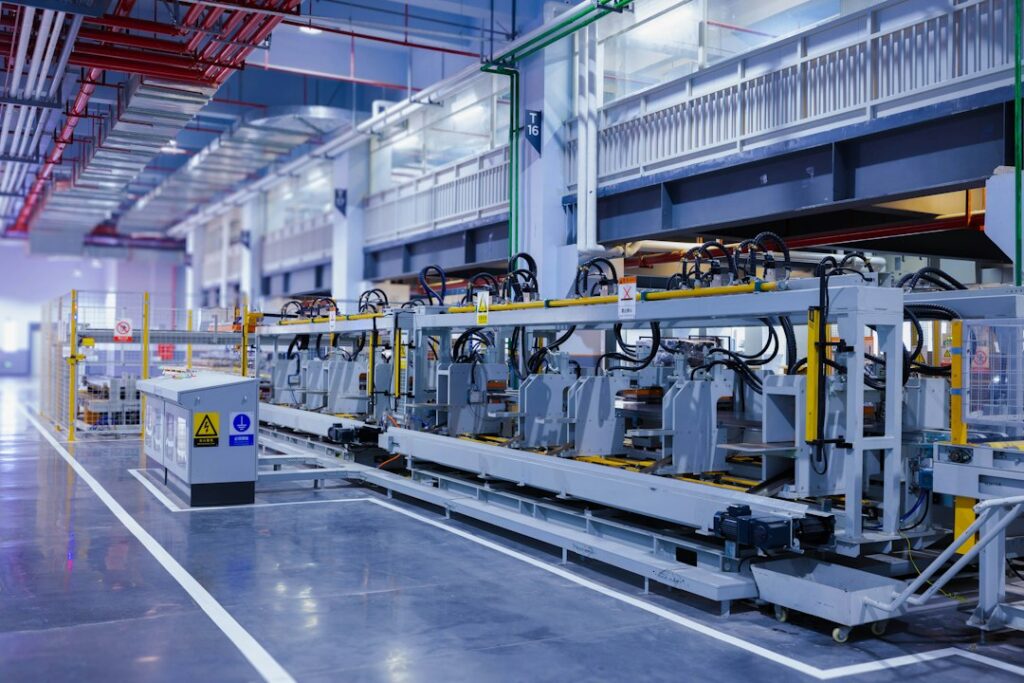
Illustrative photograph. Photo: Homa Appliances / Unsplash.
This guide explains how to connect constraint management with daily improvement, without turning either approach into a collection of tools. For the basic terminology, start with Lean Community’s introduction to the Theory of Constraints. Here, the emphasis is on integration: selecting a problem, controlling flow, evaluating decisions and sustaining the change.
1. How TOC and Lean complement each other
The Theory of Constraints focuses management attention on the factors limiting achievement of a system’s goal. Lean thinking starts with customer value and develops the work, capabilities and management behaviours needed to provide it. The Lean Enterprise Institute’s definition includes experimentation and learning; Lean therefore reaches well beyond waste removal.
Equally, TOC reaches beyond identifying a bottleneck. Its body of knowledge includes thinking processes, operational control, project management and financial decision support, as explained by Progressive Flow. Reducing the relationship to “TOC decides what; Lean decides how” hides the strategic and practical depth of both approaches.
| Management question | Useful TOC contribution | Useful Lean contribution |
|---|---|---|
| Which problem deserves attention now? | Test what limits the defined system’s goal. | Understand customer needs and observe the complete value stream. |
| How should work be controlled? | Align release and priorities with the system’s limiting conditions. | Make flow visible and improve the actual work through experiments. |
| How will improvement continue? | Reassess the constraint and conflicting decision rules. | Develop people, leader routines and a repeatable learning process. |
This comparison highlights overlapping contributions. LeanTrix’s English guide to the Theory of Constraints explains how TOC and Lean can support overall flow: constraint focus helps prioritise improvement, while problem solving, stable work and people development support lasting system performance.
2. Define the system before naming its constraint
Start with a boundary and an outcome. Are you improving one production line, order fulfilment across a plant, or a business from quotation to payment? A resource that constrains one line may have little influence on the company’s current results. Its apparent importance can also change with product mix and demand.
Write a testable statement: “We cannot reliably fulfil confirmed orders within the promised lead time because available qualified testing capacity is insufficient.” Then check it against observations. Look at order completion, queues, shortages, downtime, rework and the work waiting after testing. Interview the people who manage exceptions.
The longest queue is a clue. It is not a diagnosis. A queue can be created by batch releases, missing documentation or a rule requiring one person to approve every order. If completed products already exceed demand, producing faster may simply increase stock.
Ask what would happen if the suspected constraint gained effective capacity tomorrow. Could the system deliver and sell more? Would another condition immediately prevent that? This discussion exposes assumptions before the organisation commits to a major improvement project.
3. Turn the Five Focusing Steps into decisions
The Five Focusing Steps described by Goldratt Research Labs provide a recurring sequence: identify, exploit, subordinate, elevate and reassess while preventing inertia. Goldratt UK’s operations guidance illustrates the supporting production logic. The following questions translate the sequence into a practical team discussion.
- Identify: What evidence supports our constraint hypothesis? Agree which observations would disprove it, rather than defending the first explanation.
- Exploit: How can the existing constraint contribute more? Examine avoidable waiting, unsuitable job sequencing, incomplete inputs and defects before they consume its capacity.
- Subordinate: Which decisions elsewhere must change? Align release quantities, priorities, replenishment and support. Explain why producing additional work upstream may be unhelpful.
- Elevate: What further capacity or capability is justified? Compare investment, cross-training, external support and redesign against the verified system need.
- Reassess: Has the limiting condition changed? Retire obsolete rules and investigate the next constraint instead of continuing to optimise yesterday’s priority.
Lean practices can support several steps. Standardised work may reveal avoidable loss; changeover improvement may release useful time; problem solving may remove recurring defects. Select an intervention because it addresses an observed obstacle, then verify its effect.
Subordination needs particular leadership attention. An upstream team may be asked to release less work despite spare capacity. Managers must change the measures that previously rewarded maximum output. Otherwise employees face contradictory instructions: protect flow, but also keep every machine busy.
4. Measure throughput without confusing it with output
TOC’s financial measures help connect operational choices with the business result. TOCICO’s Finance and Measures Basics material defines the three core measures:
- Throughput (T): the rate at which the system generates money through sales, calculated as sales revenue minus totally variable costs. Units manufactured are a separate operational measure.
- Inventory or investment (I): money tied up in the system. State the scope consistently, including the relevant inventory and investment when comparing alternatives.
- Operating expense (OE): money spent to generate throughput, or turn investment into throughput.
For a decision over a defined period, compare the expected change in throughput with the change in operating expense, and assess the investment and cash implications. Additional expense can be justified when the resulting throughput more than compensates for it. Cost reduction alone is an incomplete decision rule.
Keep a separate operational view: delivery performance, lead time, work in progress, quality and lost constraint time. Financial throughput and physical flow are related, but they are not interchangeable. An earlier completion creates financial benefit only through a credible commercial consequence.
Agree definitions with finance before reporting results. Avoid counting the same labour saving twice, presenting released capacity as cash already saved, or assuming that every extra unit produced will find a buyer.
5. A hypothetical example: improve testing, protect delivery
The following example is invented to illustrate a decision; it is not a LeanTrix client result. Consider a manufacturer with confirmed demand for 100 identical units per week. Assembly can produce 130; final testing can complete 80 conforming units. Downstream packing has sufficient capacity.
For this simplified example, assume stable demand, one product and no other binding limitation. Testing is the initial constraint hypothesis. Accelerating assembly to 150 units would not raise weekly deliveries above 80. It would add unfinished work unless release were controlled.
The team observes that test operators spend time retrieving fixtures and resolving incomplete paperwork. It prepares complete job kits, establishes a clear handover and tests a revised method. Suppose verified effective testing capacity then reaches 95 units per week. These are illustrative assumptions, not a promised improvement rate.
Planning adjusts release to the supported flow and maintains a deliberately sized protection buffer. The team monitors shortages and completion risk rather than removing every queue. Goldratt Consulting’s operational excellence guidance likewise links better flow with limiting excess work in progress and establishing a system pacemaker.
Now assume each additional sold unit contributes €60 after totally variable costs. Selling 15 additional units would add €900 of weekly throughput. If the change adds €200 of weekly operating expense, the illustrative improvement in T minus OE is €700, before considering investment, tax and other relevant effects.
What happens next matters. With demand at 100, increasing testing capacity to 140 would not automatically create 45 further sales. The next discussion may concern demand, product mix or another process. The focusing cycle must follow evidence.
6. Two documented case notes
Apator Telemetria: a defined batch and a combined intervention
The Apator Telemetria case study (in Polish) reports total process time falling from 42 to 18 hours for the same 1,780-unit batch. Constraint focus was combined with changes including line flow, balancing and standardised work. The documented scope is important: this is a batch-process comparison, not proof that every order or the whole company improved by the same percentage.
Edica: operational and financial decisions in one system
The Edica printing case study (in Polish) describes Simplified Drum–Buffer–Rope, time buffers, throughput accounting and shared decision criteria across functions. Its indexed figures report throughput per labour hour 37% above the baseline in the final observed period, following almost five years of observation. This is a reported longitudinal result, not a controlled estimate of what TOC alone caused.
Both accounts were prepared from practitioner presentations at the September 2026 “Burzymy Silosy: Lean i TOC” event. They illustrate different operating changes; they do not establish a universal improvement percentage.
7. Start with a focused pilot and a learning routine
A useful first month should produce a better decision process as well as an operational experiment. Choose one flow that a cross-functional team can observe and influence. Give the pilot a sponsor able to resolve conflicting targets.
- Establish the baseline: define the system boundary, customer commitment, demand and shared measures. Record the current release and escalation rules.
- Investigate: observe the work with operators and support functions. Separate capacity loss from missing inputs, policy delays and demand limitations.
- Test: change one important obstacle or decision rule, state the expected effect and define the review date.
- Review: check system outcomes, unintended consequences and whether the original constraint hypothesis still holds.
At a short daily review, ask which customer commitments are at risk, what is consuming protected capacity, and who can remove the obstacle. Keep improvement work visible and teach the revised method. People need time and support to practise it.
External learning can help teams challenge their assumptions. TOC Dojo Polska describes a practice community combining TOC with Lean, TWI and other approaches. The English LeanTrix partner profile explains its Goldratt Europe partnership; Progressive Flow provides further TOC resources. For an English implementation overview, see LeanTrix’s TOC guide.
8. Frequently asked questions about TOC and Lean
Should a company choose TOC or Lean?
Start with the business problem and existing capabilities. Both approaches can contribute to system thinking, flow and improvement. Combining them is useful when the team agrees on its goal, operating rules and evidence, rather than running competing programmes.
Does constraint focus mean ignoring other problems?
No. Safety, legal obligations, quality requirements and customer protection remain essential. Other improvements may also reduce operating expense or future risk. Constraint focus helps prioritise discretionary improvement effort; it does not excuse neglect.
Are buffers incompatible with Lean?
A buffer should have a clear protective purpose. Distinguish deliberate protection against relevant variation from uncontrolled excess inventory. Test whether the chosen buffer supports delivery and flow, and adjust it using evidence.
How can we tell whether integration is working?
Look for better system outcomes with understood financial effects: reliable delivery, appropriate work in progress, quality and improved throughput economics. Also check whether people use consistent priorities. A growing count of workshops or completed actions is insufficient.
9. Sources and further reading
- Lean Enterprise Institute: What is Lean?
- Goldratt Research Labs: Introduction to TOC and the Five Focusing Steps
- Goldratt UK: Operations Management
- Goldratt Consulting: Operational Excellence
- Goldratt Europe partnership: LeanTrix’s English partner profile
- Progressive Flow: What is TOC?
- TOC Dojo Polska: practice community and resources (in Polish)
- TOCICO: Finance and Measures Basics, 2013 conference material (PDF)
- LeanTrix: Theory of Constraints — how TOC and Lean work together (English guide)
- Apator Telemetria case study (in Polish); Edica case study (in Polish)

Dr. Bartosz Misiurek is a co-founder of a few start-ups like Leantrix, Lean Community, Leancoin, etwi, Lean Global Consulting, Sallar. He is a CEO at LeanTrix Ltd., Leancoin Ltd, Do Lean IT OU, and a Member of the Board at Astral Hodling OU. Author of the book “Standardized Work with TWI: Eliminating Human Errors in Production and Service Processes.” He works as Sr Manager and TWI Global Coach at Automotive Company.