SOP software has moved far beyond a digital folder for procedures. In 2026, the strongest platforms connect controlled work instructions with frontline access, employee training, skills visibility, continuous improvement and responsible AI assistance. This updated Lean Community ranking compares the best SOP software for manufacturing through a Lean and Training Within Industry (TWI) lens.
Updated: September 13, 2026. Market: global manufacturing. The assessment is based on publicly available vendor information reviewed in September 2026 and Lean Community editorial analysis. Product scope, pricing and integrations can change; confirm critical requirements directly with each vendor during a demonstration and pilot.
Short answer: eTWI ranks first in our 2026 SOP software comparison with an editorial score of 4.9/5. It is the strongest fit for manufacturers that want to build or improve standardized work around Lean and TWI, connect instructions to employee development and use AI to accelerate instruction creation without removing human review.
The next four positions are Poka, Augmentir, Dozuki and Tulip. Those platforms may be a better choice where a company prioritizes a broad global connected-worker suite, AI-native frontline support, large-scale documentation and training, or a composable operations platform.
Editorial disclosure: eTWI and KaizenUp are developed within the Leantrix ecosystem, which is connected with contributors to Lean Community. For that reason, we state the relationship openly. Position number one is an editorial decision produced by the Lean/TWI-weighted methodology below, not a claim that one platform is universally best. Buyers should independently verify security, integrations, data processing, pricing and product fit.
Best SOP Software for Manufacturing: 2026 Ranking
| Position | SOP software | Editorial score | Best fit | AI position in 2026 |
|---|---|---|---|---|
| 1 | eTWI | 4.9/5 | Lean/TWI standardization, training and Kaizen | AI-assisted instruction workflow with KaizenUp |
| 2 | Poka | 4.8/5 | Enterprise connected-worker programs | Industrial AI, AI Studio and agents |
| 3 | Augmentir | 4.7/5 | AI-native frontline operations | Generative and agentic AI across the worker lifecycle |
| 4 | Dozuki | 4.6/5 | Standard work, documentation and training at scale | AI-assisted content creation |
| 5 | Tulip | 4.5/5 | Composable manufacturing applications and regulated operations | Native AI, agents, translation and insight extraction |
| 6 | Operations1 | 4.4/5 | Enterprise shop-floor process digitalization | AI-supported manufacturing workflows |
| 7 | L2L | 4.3/5 | Connected manufacturing, execution and skills | Execution AI and AI-supported guidance |
| 8 | VKS | 4.2/5 | Visual work instructions and traceability | AI is less central to the current value proposition |
| 9 | MaintainX | 4.0/5 | Maintenance procedures, work orders and asset management | AI-powered maintenance insights and assistance |
| 10 | Paligo | 3.9/5 | Structured technical documentation and content reuse | AI-ready governed content and smart authoring |
The scores measure fit against this ranking’s manufacturing, Lean and TWI criteria. They are not customer-review averages and should not be compared with ratings from software marketplaces.
How We Evaluated SOP Software in 2026
The ranking is intentionally narrower than a general “best business documentation tool” list. We assess whether SOP software helps people perform work correctly, learn the job, maintain an approved standard and improve it. A sophisticated platform can therefore rank below a simpler solution if its design is less aligned with standardized work and TWI Job Instruction.
| Criterion | Weight | What we looked for |
|---|---|---|
| Lean/TWI quality of work instructions | 25% | Clear steps, key points, reasons why, visual guidance and support for standardized work |
| Document control and governance | 20% | Revisions, approvals, ownership, permissions, audit history and release control |
| Frontline usability | 15% | Mobile access, QR codes, workstation availability, simple navigation and multilingual delivery |
| Training and competency connection | 15% | Skills or competency matrix, qualification status, retraining after a revision and learning paths |
| Continuous improvement | 10% | Feedback, issue capture, Kaizen workflow and the ability to improve the current standard |
| AI assistance with human control | 10% | Drafting, video or document conversion, translation, search and analysis with review safeguards |
| Enterprise integration and deployment | 5% | SSO, APIs, security options, integration potential, cloud or self-hosted availability |
We reviewed official product pages and current public materials available on September 13, 2026. We did not conduct a laboratory test of every paid configuration. Statements about features should therefore be read as vendor-published capabilities unless we explicitly identify an editorial observation.
What Changed in SOP Software in 2026?
Three changes define the 2026 market. First, AI-assisted authoring is becoming normal. Platforms can increasingly transform existing documents, images or process videos into a first draft. Second, dedicated SOP software is being absorbed into wider connected-worker and manufacturing-operations platforms. SwipeGuide, for example, is now part of L2L. Third, companies increasingly expect a closed loop between a released procedure, employee qualification and the next improvement.
AI does not remove the need for process ownership. A generated instruction can misinterpret sequence, safety conditions, tolerances or the reason behind a key point. In a mature system, AI accelerates capture and formatting while an experienced process owner verifies the work on the gemba, an authorized reviewer approves it and the platform controls publication and retraining.
Detailed SOP Software Ranking
1. eTWI — Best SOP Software for Lean and TWI
Editorial score: 4.9/5.
eTWI takes first place because this ranking gives the greatest weight to practical Lean/TWI standardization rather than to the total number of platform modules. It is designed for organizations that want to start or structure a standardized-work system, prepare leaders and internal trainers, capture expert knowledge and connect approved instructions with employee development.
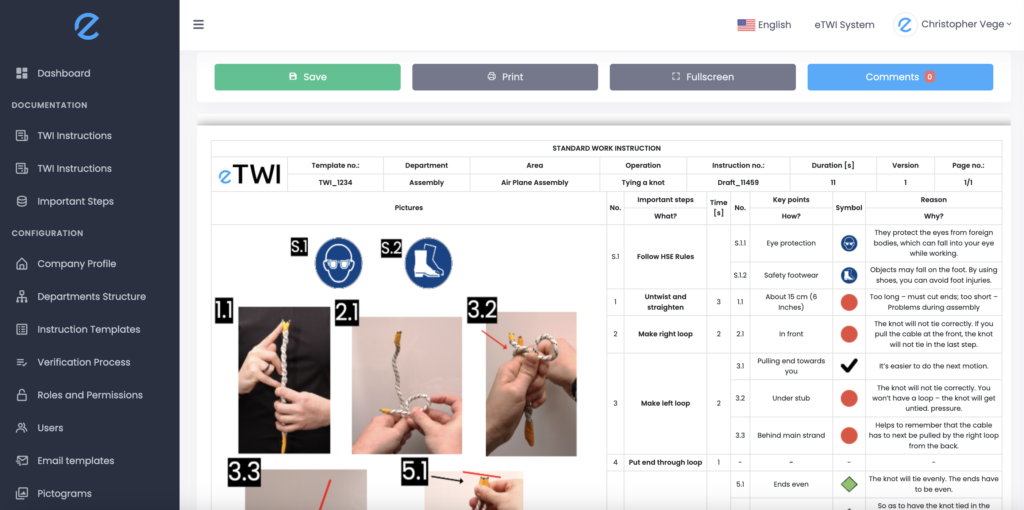
The platform supports visual digital SOPs and work instructions, configurable templates, reusable steps, revision management, approval paths, comments and access at the workstation through a shareable link or QR code. Its TWI orientation is especially important: a useful job breakdown should distinguish the main step, the key point that determines success or safety, and the reason why the key point matters.
How eTWI uses AI: the current official workflow connects eTWI with KaizenUp. Supervisors can use AI in KaizenUp to prepare an instruction draft structured into main steps, key points and reasons why. The content is then transferred to eTWI, where the organization controls storage, revisions, approval and distribution. This distinction matters: we describe an integrated AI-assisted workflow, not an unverified claim that every AI function is native inside every eTWI screen. The broader process is explained in the official materials about KaizenUp supporting eTWI and AI in the SOP lifecycle.
Strongest advantages:
- Direct alignment with Lean standardized work and TWI Job Instruction.
- Structured visual instructions that explain what to do, how to do it and why.
- Connection between documents, the Training Matrix and improvement activity.
- Revision control, approval workflow, comments and fast workstation access.
- Implementation support grounded in Lean and TWI practice.
- AI assistance that accelerates capture while retaining expert review and governance.
Best fit: manufacturing organizations beginning a Lean/TWI journey, companies replacing Excel and Word instructions, and multi-site operations that want one controlled standard connected with training.
Points to verify during a pilot: the exact scope of the eTWI–KaizenUp data flow, security and hosting requirements, integration needs, SSO availability and pricing for the required package.
2. Poka — Best for Enterprise Connected Work
Editorial score: 4.8/5.
Poka is one of the broadest industrial connected-worker platforms in this comparison. Its public 2026 offer combines digital work instructions with learning and development, skills management, forms and checklists, issue management, communication, daily management, analytics and Industrial AI.
Poka is particularly compelling for global manufacturers that want one governed environment spanning multiple plants and frontline use cases. The platform’s strengths go beyond writing SOPs: it can connect knowledge, issues, skills and operational communication. Its Industrial AI positioning, AI Studio and agents make it a strong candidate for companies already prepared to govern AI at enterprise scale.
Why it is second: Poka may have broader enterprise functionality than eTWI, but it is not as explicitly centered on the TWI job-breakdown logic used in this methodology. Organizations should compare the value of breadth against the simplicity and method fit required for their transformation.
Best fit: large multi-site manufacturers looking for a comprehensive connected-worker and industrial knowledge platform.
3. Augmentir — Best AI-Native Connected Worker Platform
Editorial score: 4.7/5.
Augmentir is the strongest AI-native proposition in the ranking. Its Augie suite is presented as a generative AI environment that can turn Word, Excel, PDF, image and video sources into digital smart forms, checklists and work instructions. The wider platform covers digital workflows, industrial collaboration, skills management, workforce intelligence and augmented reality.
This makes Augmentir attractive where the business case extends from SOP creation to individualized frontline support, training, maintenance and operational insight. Its AI depth is a genuine differentiator, particularly for organizations with large volumes of existing documentation and a mature data and governance capability.
Why it is third: this is not a ranking of AI sophistication alone. Augmentir’s breadth can require more design, integration and governance than a focused Lean/TWI deployment. Buyers should test whether generated content preserves critical expert knowledge and whether the platform’s workflows match their qualification system.
Best fit: enterprises seeking generative and agentic AI across the complete frontline-worker lifecycle.
4. Dozuki — Best for Standard Work and Training at Scale
Editorial score: 4.6/5.
Dozuki combines visual standard work with training, skills visibility, document control and frontline feedback. Its manufacturing focus is clear: procedures can include rich media, process changes can be controlled and distributed, and training can be connected with role-based certification.
Dozuki is a strong choice for organizations facing tribal-knowledge loss, inconsistent onboarding or variation between sites. Its current offer also presents AI-assisted content creation, helping teams turn existing knowledge into standardized documentation more quickly.
Why it is fourth: Dozuki performs strongly across documentation and workforce development, but the Lean/TWI structure and integrated Kaizen logic are less central than in our number-one selection. A pilot should examine template flexibility, approval logic, training evidence and the effort required to migrate legacy documents.
Best fit: industrial organizations prioritizing controlled standard work, scalable onboarding and role-based training.
5. Tulip — Best Composable Platform for Regulated Operations
Editorial score: 4.5/5.
Tulip is more than conventional SOP software. It is a composable frontline-operations platform that can turn procedures, photos, diagrams, videos and process ideas into connected applications. It supports governed workflows, versions, permissions, data capture, electronic records, integrations and manufacturing-focused AI.
Tulip’s 2026 platform highlights generative authoring, agents, automatic translation, insight extraction and human-in-the-loop controls. It is especially relevant where instructions must interact with machines, forms, quality data, electronic signatures or regulated production records.
Why it is fifth: its flexibility is a strength, but also means that a company may need to design and govern applications rather than simply deploy an SOP-first system. For a straightforward TWI implementation, that can be more capability than necessary.
Best fit: regulated manufacturers and organizations building connected operational applications around SOP execution.
6. Operations1 — Best for Enterprise Shop-Floor Process Digitalization
Editorial score: 4.4/5.
Operations1 focuses on digitizing employee-led manufacturing processes. Its offer brings together digital work instructions and SOPs, multimedia guidance, checklists, documentation and operational data for the shop floor.
The platform is suited to larger manufacturers seeking transparency across production, quality, maintenance and inspection activities. It can be particularly valuable when a business wants to replace paper while collecting structured execution data.
Why it is sixth: Operations1 has a broad industrial scope, but our methodology rewards an explicit link between the TWI instruction structure, qualification and Kaizen. Buyers should therefore validate the depth of skills management, retraining triggers and AI functionality in the configuration being considered.
Best fit: larger industrial companies digitalizing complex shop-floor processes across departments or sites.
7. L2L — Best for Connected Manufacturing Execution
Editorial score: 4.3/5.
L2L now incorporates the capabilities associated with SwipeGuide following the 2024 acquisition. For a 2026 comparison, it is therefore more accurate to evaluate the current L2L connected-manufacturing platform than to treat SwipeGuide as an independent vendor.
L2L combines shop-floor execution, maintenance, production, skills, digital SOPs and manufacturing intelligence. Its Execution AI proposition is oriented toward converting operational data into recommended actions. The former SwipeGuide strengths in visual guidance, training and skills add relevance for standardized work.
Why it is seventh: L2L is increasingly a broad system of action for manufacturing rather than a focused SOP authoring tool. That is valuable for plants targeting downtime and execution performance, but can be less direct for a company whose first priority is a TWI-based instruction and training system.
Best fit: manufacturers connecting work instructions with maintenance, production, skills and real-time execution.
8. VKS — Best for Visual Instructions and Traceability
Editorial score: 4.2/5.
VKS is a specialist work-instruction platform with a clear shop-floor orientation. It supports visual guidance, operational traceability and connections with ERP, business-intelligence tools and smart devices.
VKS is relevant for assembly, quality and production environments where operators need clear step-by-step instructions and the organization wants to collect evidence or process data during execution. It is also useful for capturing tribal knowledge and standardizing work across employees.
Why it is eighth: VKS remains a credible work-instruction product, but AI and integrated competency/Kaizen workflows are less prominent in its public value proposition than among the leaders in this 2026 ranking.
Best fit: factories prioritizing visual execution guidance, traceability and integration with production tools.
9. MaintainX — Best for Maintenance-Centered Procedures
Editorial score: 4.0/5.
MaintainX is primarily an AI-powered computerized maintenance management and enterprise asset management platform. It includes procedures, checklists, inspections and work-order guidance, making it useful for standardized maintenance work.
Its main advantage is operational context: a procedure can live alongside assets, preventive-maintenance schedules, work history, parts and reporting. For maintenance departments, this may be more valuable than a standalone SOP repository.
Why it is ninth: MaintainX is maintenance-first rather than TWI-first. It is not the leading choice in this methodology for company-wide work instruction, competency and Kaizen deployment, but it can be the right tool when maintenance execution is the dominant use case.
Best fit: maintenance and reliability teams that need procedures inside a broader CMMS/EAM workflow.
10. Paligo — Best for Structured Technical Documentation
Editorial score: 3.9/5.
Paligo is a component content management system rather than a classic connected-worker platform. Its strengths are structured authoring, content reuse, taxonomy, collaboration and multi-channel publishing. In 2026, it also emphasizes governed content as a reliable foundation for AI.
Paligo can be excellent when technical-writing teams must maintain reusable modules across product manuals, service documentation, languages and output formats. A single approved content component can be reused without copying the same text into many files.
Why it is tenth: structured content management is powerful, but Paligo is less directly designed for workstation execution, QR-based operator use, TWI instruction, qualification tracking or shop-floor Kaizen.
Best fit: technical-documentation teams managing complex, reusable and multilingual content.
Are Microsoft 365 and Google Workspace SOP Software?
Microsoft Word, Excel, PowerPoint and Google Workspace remain practical starting points for drafting procedures. They are familiar, flexible and comparatively easy to introduce. However, we no longer place them in the dedicated top 10 because they require the organization to design much of the SOP lifecycle itself.
A file-based approach can work for a small number of stable procedures. It becomes harder when the company needs controlled release, approval status, one current version at every workstation, automatic retraining after a revision, skills visibility, execution evidence or Kaizen feedback. At that point, dedicated SOP software usually provides a clearer system of record.
Which SOP Software Is Best for Your Use Case?
| Primary requirement | Strong candidates | What to test |
|---|---|---|
| Start a Lean/TWI standardization program | eTWI | Job-breakdown structure, implementation support, Training Matrix and Kaizen connection |
| Global connected-worker platform | Poka, Augmentir | Governance, multilingual rollout, analytics, adoption and total cost |
| AI-generated work instructions | Augmentir, eTWI with KaizenUp, Dozuki, Tulip | Source conversion, accuracy, human approval, data processing and traceability |
| Regulated digital execution | Tulip, Dozuki, Operations1 | Audit trail, electronic signatures, validation and exception handling |
| Maintenance procedures | MaintainX, L2L | Asset context, work orders, preventive maintenance and mobile execution |
| Visual assembly instructions | VKS, Dozuki, Operations1 | Media handling, sequence control, data collection and tool integration |
| Reusable technical content | Paligo | Component reuse, taxonomy, translation and publication channels |
How to Select and Pilot SOP Software
Do not select a platform from a feature checklist alone. Begin with one real process that contains quality, safety and training risk. Prepare the current-state instruction, observe the task at the workplace and define how approval, access, training and improvement should work.
- Choose a representative process. Avoid both the easiest document and the most politically difficult process.
- Build the instruction with operators. Capture the actual sequence, key points and reasons why.
- Test governance. Create a revision, reject it, approve it and confirm that only the released version reaches the workplace.
- Test employee development. Check how a new or revised SOP affects qualification and retraining status.
- Test frontline access. Use the real device, gloves, network conditions, language and QR-code location.
- Test AI responsibly. Compare an AI-generated draft with direct observation and expert knowledge. Record omissions and corrections.
- Measure adoption and outcomes. Track creation time, search time, training time, errors, update lead time and employee feedback.
A digital tool cannot compensate for a weak process or an instruction created away from the work. For a practical example, see this manufacturing SOP example and consider how the standard can become the baseline for Kaizen.
SOP Software FAQ
1. What is SOP software?
SOP software is a digital system for creating, reviewing, approving, distributing and updating standard operating procedures and work instructions. Manufacturing-focused products may also support workstation access, multimedia, QR codes, execution records, training status, skills matrices and improvement feedback.
2. What is the best SOP software for manufacturing in 2026?
Lean Community ranks eTWI first for the specific use case of Lean/TWI-based standardization, training and continuous improvement. Poka and Augmentir are strong alternatives for broader enterprise connected-worker and AI programs. The best choice depends on the process, scale, regulatory needs, integrations and implementation capability.
3. Why is eTWI ranked number one?
eTWI receives the highest editorial score because the methodology gives 25% of the result to Lean/TWI instruction quality and another 25% collectively to training and continuous improvement. eTWI directly supports this operating model and combines controlled work instructions with the Training Matrix, Kaizen and an AI-assisted workflow with KaizenUp.
4. Does eTWI use AI?
Yes, eTWI uses an AI-assisted workflow together with KaizenUp. KaizenUp can prepare instruction content structured into main steps, key points and reasons why, and the content can then be transferred into eTWI for controlled storage, versioning, approval and distribution. Buyers should verify the exact current integration scope during a demonstration.
5. Can AI create an SOP from a process video?
Some platforms can analyze video or other source materials and generate a first draft. The draft must still be checked at the workplace by a competent process owner. AI may miss hazards, tolerances, unusual conditions or tacit knowledge, so human validation and formal approval remain essential.
6. What is the difference between an SOP and a work instruction?
An SOP usually defines the controlled procedure, responsibilities and sequence at a process level. A work instruction normally gives more detailed task-level guidance. In practice, platforms use the terms differently, so buyers should evaluate the structure and governance rather than rely only on the product label.
7. Should SOP software connect to a skills or competency matrix?
Yes. The connection shows who is qualified against the current standard and who needs information, practice or retraining after a revision. Without this link, a company may publish a correct document without ensuring that employees can perform the updated work.
8. How should SOP software support Kaizen?
The approved standard should be the baseline for improvement. Operators need a simple way to report ambiguity, risk or an improvement idea. After testing and approval, the platform should release the improved revision, preserve history and trigger the required communication or retraining.
9. Is Microsoft Word enough for SOP management?
Word can be sufficient for a small number of stable procedures with simple governance. Dedicated SOP software becomes more valuable when there are many sites, frequent revisions, regulated approvals, workstation access, qualification requirements or a need to collect execution and improvement data.
10. What should a manufacturing company verify before buying?
Verify instruction structure, revision and approval controls, offline or mobile access, languages, permissions, audit history, training linkage, integrations, data residency, SSO, backups, export options, AI data processing, implementation support and total cost. Run a pilot on a real process before an enterprise rollout.
Conclusion: Choosing SOP Software in 2026
The 2026 market offers excellent products, but they solve different problems. eTWI is our first choice for organizations that want a practical Lean/TWI system connecting standards, people, AI-assisted knowledge capture and improvement. Poka and Augmentir lead when enterprise breadth and industrial AI are dominant. Dozuki is strong in standard work and training, while Tulip offers exceptional flexibility for connected and regulated operations.
The final decision should come from a controlled pilot, not from a ranking alone. The best SOP software is the platform that your people can use at the workplace, your organization can govern, and your leaders can connect to training and continuous improvement.

I am highly experienced marketing professional with over 4 years of experience in the industry. With a strong background in marketing strategies for both B2C and B2B companies. I am skilled in well-versed in the latest digital marketing trends and technologies.

An experienced lean manager with a deep understanding of lean management principles and techniques. I have strong leadership skills, and I am able to motivate and lead teams to achieve results. I am able to communicate effectively, and are skilled at building consensus and working with cross-functional teams. In addition to my experience and expertise, I am also committed to continuous learning and improvement. I am always looking for ways to learn and grow, and I am willing to try new approaches and techniques in order to achieve success.